Wednesday, February 22, 2023

Beneficial Features of Using Lithographic Printing


One would probably imagine that a printing technique which was invented in the 18th century would be out-of-date by now. But lithographic printing has evolved over the years and its modern version continues to be a popular and practical option for printing. This form of printing, also called litho, offset, or plate printing, was invented in 1798 as a modern alternative to copperplate engraving which was the prevalent technology.


Despite the growing popularity of digital printing over the last 25 years, litho printing is still used for printing magazines, hardcover books, brochures, catalogs, and also for booklet printing. So, let’s see what makes this technology still relevant and popular.


What is Lithographic Printing?

In this printing technique, the image of the content to be printed is placed on a plate. This plate is then covered in ink and the material is placed against this plate. The inks from the plate are absorbed onto the material. The initial setup of creating the plates and preparing the inks is time-consuming and requires precision. The inks must be mixed precisely and used in the correct order. The output is of high quality with precise and vibrant colors.


Since the initial preparation takes more time, litho printing is more suitable for large runs. If you need book printing services for a small number, then digital printing would be a better option. However, the high-quality print and precision obtained with litho printing makes it a practical choice in many situations.


What are the Advantages of Litho Printing?

When it comes to book printing, Melbourne vendors offer many different techniques like digital, flexography, screen, and lithographic printing. Whether you are looking at printing hardcover books, manuals, flyers, or booklet printing, the technique you opt for will depend on the desired finished look, budget, volume of the print run, and timeframe. Let us see how litho printing stacks up under these parameters so you can decide if it is a good fit for your printing requirement.


Advantages of Lithographic Printing


Quality –

Litho printing is the best option for high-quality printing on a smooth surface. This printing technique gives output that is high in sharpness and clarity. With this method, you can do long runs of printing without losing quality. This makes litho printing a great choice for printing art reproductions, posters, and for custom book printing with images and illustrations. Another advantage of this method is that it does not leave impressions on the back of the page, which not only gives a better reading experience, but it also keeps the book light.


Cost-effectiveness –

With lithographic printing, the unit cost decreases as the quantity increases. This makes it a great option for bulk printing. The main cost component is that of the initial setup. Every subsequent rerun is very cost-effective. So, even if your need is for custom book printing but with chances of follow-up reruns, you should consider this printing method. It will be easy on your pocket in the long run.


Versatility –

Litho printing has the distinct advantage that it can be used for a variety of paper weights and types. You can also opt for different finishes like glossy and matte. In fact, you can use this method of printing on other surfaces too if it is smooth and practical. So, you can get creative with your printing surface by exploring materials like leather, wood, cloth, plastic, metal, etc.


Time efficiency –

The creation and preparation of the plates takes time. But the printing itself is very efficient. With litho printing, you can get a printing speed of over 50,000 sheets per hour. This speed makes this method such an attractive option for large print runs and for book printing services that require reruns.


Conclusion

So, if you are looking for book printing services that work well for high volume and yield high-quality output, then lithographic printing is an excellent choice for you. The newer advancements made in this technology make it a great option for printing hardcover books, magazines, art reproductions, and even booklet printing.


When it comes to book printing in Melbourne, look no further than Print Books. We have over 20 years of experience in printing using different techniques. Our design and print teams excel at understanding the client’s needs and offering printing solutions and services best suited to those needs. Whether it be large runs or small ones, our team delivers quality within your budget. So, what are you waiting for? Contact us now to get a free consultation.

Source: Advantages of lithographic printing

Thursday, February 2, 2023

Perfect Binding vs. Saddle Stitch Binding: Which is the Best Option?

 If you are looking to get a book printed, you certainly have to look at options for book binding. You will be surprised at the variety of options available for binding. It can get confusing to decide which is the best book binding option for your book. You can choose from perfect binding, binding for hardcover books, wire binding, spiral binding, saddle stitch binding, etc.

The two most popular types of binding used in book printing in Melbourne are perfect binding and saddle stitch binding. We deep dive into these and explore their advantages and disadvantages so you can decide which one of these two book bindings is ideal for your book.

What is Saddle Stitch Binding?

In this method of book binding, the sheets of the book are nested inside one another and stapled along the inside fold. It is mostly used for brochures, programs, thin magazines, etc. These are ideal for book and booklet printing of up to 48 pages. As the pages are cut flush with the cover, as you go to the center of the book the pages get smaller in size. This is called creep. With a higher page count, the creep will be far more noticeable and hence, this method is ideal for thinner books.

Pros and Cons of Saddle Stitch Binding

Let us consider the advantages and restrictions of this book binding technique.

Merits of Saddle Stitch Binding

  • Saddle stitch binding is one of the most widely available techniques and is very cost-effective. So, it is ideal for regularly published books and booklet printing.
  • The delivery of books bound using this method can be fulfilled in far less time than many other book binding techniques.

Demerits of Saddle Stitch Binding

  • There is a limitation on the page count with this method as the staples can fall off easily with a higher number of pages and also because of the creep that sets in with more pages.
  • Customizability with paper type is much lower with saddle stitch binding. This is because the two pages on each side of the fold will be the same. So, you can’t, for example, have colored sections in this method.

Perfect Binding vs Saddle Stitch Binding

What is Perfect Binding?

In perfect binding, the book has a flat spine to which the books are glued with adhesives like PUR glue. It is best suited for books with a page count of over 96 pages. Perfect binding is used for most soft-cover books like magazines, catalogs, manuals, comics, etc. Sometimes, this technique is also used for hardcover books.

Pros and Cons of Perfect Binding?

Let us look at some of the merits and demerits of perfect binding.

Merits of Perfect Binding

  • Perfect binding gives a cleaner and more professional appearance to the book.
  • This technique of book binding also makes the book more sturdy and durable.
  • As the spine of books bound using this method is flat, it can be used for printing information about the book. When the book is placed vertically with the spine side out, the copy on the spine helps the book to stand out. So, this is great for books that need to be displayed in bookcases, bookstores, etc.
  • There is more scope for customizability with the pages in perfect binding. For example, if you are getting a diary printed, you can use pages of different colors, textures, and finishes when using perfect binding.

Demerits of Perfect Binding

  • In comparison to saddle stitch binding, perfect binding is a little more expensive. While this may not be a factor when getting just one or two books printed, it will be a significant amount if you are placing a print order for a large number of books.
  • When opting for perfect binding for book printing in Melbourne, keep in mind that this method has a higher turnaround time than saddle stitch binding.
  • Perfect binding does not work very well for books that need to be read hands-free like recipe books, instruction manuals, etc.

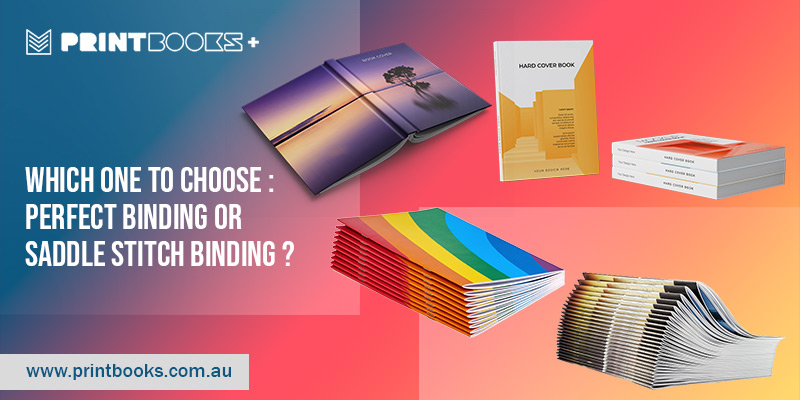
Which One to Choose: Perfect Binding or Saddle Stitch Binding?

There is no right or wrong choice between perfect binding and saddle stitch binding. Both are easily available, and both have their pluses and minuses. This choice will depend on factors like the desired final look of the book, the budget for printing, and the purpose of the book. For example, if you want a more classic look and a printable spine, go for perfect binding. Or if you are looking for a faster and cheaper print, opt for saddle stitch binding. Both techniques are widely available as options for book printing in Melbourne.

Winding Up

Both perfect binding and saddle stitch binding have their advantages and are suited for different kinds of books. Using the above analysis, you can conclude which of the two types of book binding will be perfect for your book. Whichever book binding technique you finally decide to use, you will need to engage a company with experience and expertise in book printing in Melbourne.

Our team at Print Books not only delivers high-quality book and booklet printing but also offers advisory services on the binding technique. We believe in offering our customers solutions that are tailored to their needs. We are experts in delivering premium printing and book binding services at highly competitive rates. The best part is you get all this with a very low turnaround time. Book a free consultation with our team now.

Choosing the Best Book Binding Style for Professional and Durable Printing Projects

 Selecting the right book binding style is one of the most important decisions in any printing project. The binding not only affects the app...